
/Report
An Overview of the MYP Personal Project
The report is the main component of the personal project that is assessed by your supervisors and the IB. It is broken down into 3 parts: A.Planning, B.Applying skills, C.Reflecting.

Aims
of the Personal Project


Applying skills
In this section
you are required to:
Explain what ATLs you used.
Explain why you used them.
Explain how and where you used them.
Talk about personal growth
In this section
you are required to:
Impact of your product.
Evaluating your product
Self-Evaluation.
A: Planning
In this section of the report you must demonstrate the following:
-
i. state a learning goal for the project and explain how a personal interest led to that goal
-
ii. state an intended product and develop appropriate success criteria for the product
-
iii. present a clear, detailed plan for achieving the product and its associated success criteria.
In this section you must do the following 4:
1.
Set a learning goal based on a personal interest
Your learning goal can stem from a passion, an interest in school, a service as action, an experience, a hobby or a future profession
2.
State a product goal
There should be a direct link between your learning goal and product. Your product does not need to be physical, but can be a website or app.
3.
Develop a success criteria for your product
Your success criteria must be testable, measurable and observable. It must evaluate your product and the impact on you or the community
4.
Make an action plan to achieve the product
Your action plan must be detailed and give dates and deadlines that you have created for yourself and given deadlines. Outline actions needed to achieve the product
1-2. Setting a Learning and Product goal.
Explainer video - How to set a SMART Goal:
Global Contexts - Linking to your goal (OPTIONAL)
You can use a Global Context to guide your exploration and learning goal. Look through the Global Contexts below and choose the one which fits your exploration the most. Feel free to mention the global context in your report and say how your project will explore this global context or use it to drive your inquiry.
Identities
&
Relationships
Identity
Beliefs and values
Personal health
Physical health
Mental health
Social health
Spiritual health
Human relationships, including families, friends, role models
Communities and cultures
Who am I?
Who we are?
Scientific and technical innovation
-
Students will explore the:
-
natural world and its laws;
-
the interaction between people and the natural world;
-
how humans use their understanding of scientific principles;
-
the impact of scientific and technological advances on communities and environments;
-
the impact of environments on human activity;
-
how humans adapt environments to their needs.
How do we understand the worlds in which we live?
Orientation in Space and Time
Students will explore:
personal histories;
homes and journeys;
turning points in humankind;
discoveries;
explorations and migrations of humankind;
the relationships between, and the interconnectedness of, individuals and civilizations,
from personal, local and global perspectives.
What is the meaning of ‘where’ and ‘when’?
Globalization and Sustainability
-
Students will explore the
-
interconnectedness of human-made systems and communities;
-
the relationship between local and global processes;
-
how local experiences mediate the global; reflect on:
-
the opportunities and tensions provided by world interconnectedness;
-
the impact of decision-making on humankind and the environment.
How is everything connected?
Personal and Cultural Expression
Students will explore the ways in which we:
discover and express ideas, feelings, nature, culture, beliefs and values;
the ways in which we reflect on, extend and enjoy our creativity; our appreciation of the aesthetic.
What is the nature and purpose of creative expression?
Fairness and Development
-
Students will explore rights and responsibilities;
-
the relationship between communities;
-
sharing finite resources with other people and with other living things;
-
access to equal opportunities;
-
peace and conflict resolution.
What are the consequences of our common humanity?
Prior Knowledge
Identify what you already know about the goal for your project, the sources of your knowledge and how this will help you achieve your personal project goal.
You can also draw from your MYP subjects that will help you achieve your personal project goal. You can Brainstorm or use the KWHL chart below, to help access prior information on a topic or theme or focus on a topic. You can identify primary and secondary resources, leading to the research.
KWHL Chart

3. Writing a Success Criteria
4. Writing an Action plan
B. Applying Skills
In this section of the report you must demonstrate the following:
-
i. explain how the ATL skills were applied to help achieve your learning goal.
-
ii. explain how the ATL skills were applied to help achieve your product.
In this section you must do the following 3:
1.
Select and apply ATL skills to work towards your learning goal.
Identify the ATL skills that you have applied through achieving your learning goals and explain how these skills were developed
2.
Select and apply ATL skills to work towards your product goal.
Identify the ATL skills that you have applied through creating your product and explain how these skills were developed.
3.
Gather evidence showing how you have used the ATL skills in your project
You must gather detailed evidence. This could be the process journal or research that you have undertaken to achieve your product and learning goal
1&2. Selecting ATL skills.
Approaches to learning (ATL) are a framework of skills which help you develop as an independent learner. There are 5 skill categories (yellow innner circle).
These break down further into clusters (outer circle of diagram). For each cluster there are specific skills that you may use. There are over 130 of these skills. You are not expected to demonstrate all of these skills within each cluster but only select the relevant ones.

Navigate through the tabs below to see the ATL skills for each category:


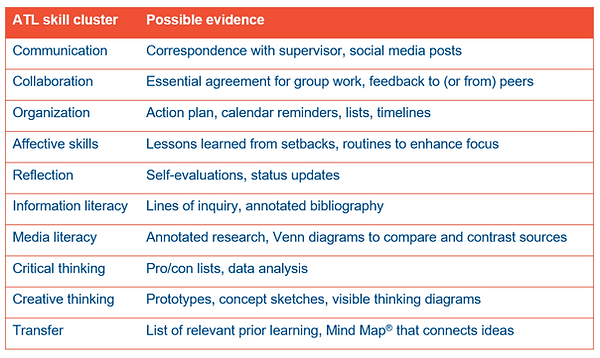
An example table showing the ATL skill and possible evidence that can be used to demonstrate it.
3. Gathering evidence to move the project forward
You MUST research in order to successfully complete this project. Why research? Albert Einstein himself stated, “If we knew what it was we were doing, it would not be called research, would it?” (Natural Capitalism, 272)
What and where?
Use any of the following platforms to conduct research:
-
Books
-
Site visits (museums etc.)
-
Magazine articles
-
Television shows
-
Newspaper articles
-
Video recordings
-
Maps or atlases
-
Electronic databases
-
Expert people
-
Web sites
Collecting Information
As you research, record the important details regarding that source right away. Use mybib.com (citation generator) and create a project in it.
You should keep a place (eg: process journal, word doc, ppt slides, notebook etc) where you record and log your research for your whole project. You can take screenshots or photographs from this and include them into your criteria B as evidence of ATL skills.
Remember! People are sources, too! Keep track of all your sources using the MLA9 style.

3. Demonstrating Your Research Skills
In order to effectively achieve your personal project goal, you will need to research and evaluate the sources you have researched so that you can then transfer this research to your actual project.
You should select relevant and reliable information from a variety of sources to develop the personal project. The number and types of resources will vary depending upon the nature of the project:
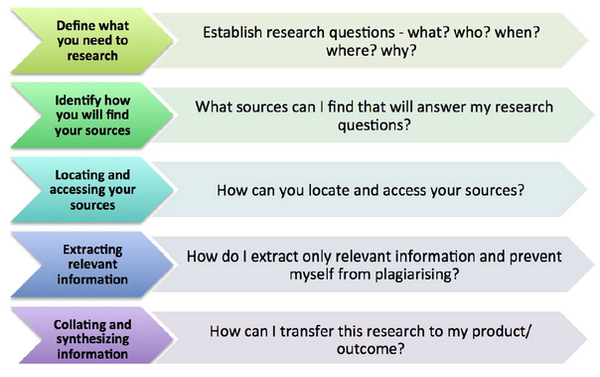
You need to ensure that you have documented your sources in your project in mybib.com. Available sources may include your prior knowledge and primary and secondary sources such as: subject area content, significant people, survey data, published media, internet resources (which provide a variety of sources), images.
You will have selected sources during the initial stage of your project but research will continue during the process of completing the project. Make sure that you build your bibliography as you research. Be ready to provide in-text citations for all sources.
3. Guidance for Collecting ATL Evidence
Pick the right amount of ATL strands
Aim for 3–4 ATL strands total, spread across 2–3 ATL categories (e.g., Self-Management, Research, Communication, Thinking).
Avoid two extremes:
-
Too many → shallow, checklist behavior.
-
Too few → weak picture of growth.
Choose strands that directly drive your goal, product, and research needs (not just what’s easy to evidence).
Tips to keep your evidence
Maintain a process journal; digital or physical, to record your progress throughout the project. This will allow you to generate clear evidence for each strand within the three project objectives.
Evidence should be:
Relevant
It clearly shows the strand in action (e.g., “I used a Gantt chart and adjusted milestones” → Organization).
Contextualized
Include the “what/why/when/with whom.”
Attributable
Shows your decisions/skills and it is directly linked and clear it relates to the ATL skill
Timestamped
Keep a log or date entry for each skill. When you practiced it.
Triangulated
3x3
Where possible, show 3+ sources for the same skill (e.g., a planning doc + supervisor feedback).
So for 3 skills show 3 evidences each
Ethical
permissioned
If including images, interviews, or surveys, get consent; anonymize where needed; cite sources.
Go in depth when you analyze evidence
A very easy and beneficial structure to use when analysing your evidence is PEEL. You may have used this in English or Humanities to analyse evidences. USe the same strcture for your own evidence
POINT
Name the ATL strand and what you did.
EVIDENCE
Attach/quote the evidence you are analysing
EXPLAIN
Explain how exactly this shows the skill. Give description and explanation
LINK
Link your explanation back to the learning goal or product goal
Checklist (use before you submit)
Use this checklist and tick off what you have done before you submit to ensure you have all steps done for this section:
-
Evidence is clearly linked to a named ATL strand.
-
I explain how the evidence demonstrates the skill (not just “I did it”).
-
I state the impact on my project (time, quality, usability, outcomes).
-
I note a next step or improvement.
-
I connect it to the relevant PP criterion.
-
Dates, permissions, and citations are in place.
c. reflecting
In this section of the report you must demonstrate the following:
-
i. explain the impact of the project on yourselves or your learning.
-
ii. evaluate your product based on the success criteria.
In this section you must do the following 3:
1.
Explain how you have changed due to your learning goal or product
Your learning goal can stem from a passion, an interest in school, a service as action, an experience, a hobby or a future profession
2.
Evaluate the product based on the success criteria.
There should be a direct link between your learning goal and product. Your product does not need to be physical, but can be a website or app.
3.
Support your comments with specific evidence or detailed examples
There should be a direct link between your learning goal and product. Your product does not need to be physical, but can be a website or app.
1. Showing change throughout the process
When writing your reflection these are some of the questions you can consider:
What have I learned about the subject?
What have I learned about myself?
What skills have I aquired?
What skills have I improved?
What am I most proud of?
How has my point of view changed?
How has my project prepared me for the future?
In this section for the highest level you should show the development of change through constant reflection. You could focus on the change, improvement or development you have made in your ATL skills. You could represent this as a table like this:

2. Evaluating the product against the Success Criteria
For this section of your personal project, you need to refer back to your specifications and criteria for success rubrics/criteria that you created and have been seeking to achieve as you took action to create your product/outcome.
Evaluate your product/outcome against the specifications you have set. Assess your work according to the achievement descriptions you specified in your rubric.
You now need to provide a justification of why you have given yourself this level against your specification. This needs to be documented in your report. If you have not achieved the top achievement levels that you set yourself, you need to justify why and explain how you could have improved your product/outcome so you could have achieved the top achievement level. A thoughtful evaluation indicating how your project could have been taken to a higher level provides a very positive outcome.

examples
Examples of Previous PP Reports & Products
Level 7
Level 6
Psychology
Learning Goal:
Causes of mental instability and possible therapy to prevent it.
Product Goal:
A book on mental health
bibliography
How to Reference and write a Bibliography
For the PP Report, the IB have requested that you must use the following referencing method:
MLA 8 (Modern Language Association 8th Edition)
There is a very easy way of referencing both "in-text" and creating a "bibliography" using www.mybib.com. The video tutorials below show how easily you can reference your research accurately and hassle-free:
TUTORIAL: How to use MyBib Chrome Extension to reference anything easily for your report.
TUTORIAL: How to create a Bibliography on MyBib.
formatting
Format for your Report
Your report must be submitted in .pdf format. You also need to consider your learning preferences and your strengths. It is so important that you communicate clearly and concisely in order to reach the highest grade possible.
Your report Must:
-
Be organised into identifiable sections following those of the criteria: A. Planning, B. Applying Skills, C. Reflecting
-
Ensure that it is no more than 15 pages long excluding the bibliography.
-
To ensure that the written part of the report is clearly legible, each page must have a minimum: 11-point font size and 2 cm margins.
-
Evidence presented in images must be clearly visible at the size submitted.
-
Audio and video must be recorded and submitted in real time.
-
Visual aids presented only in video format will not be considered for assessment.
-
The bibliography is uploaded separately and is not included in the page limit.
-
Please do not include a title page; if included it will count towards the page limit.
You should have the following things Uploaded/Completed on ManageBac
-
The Academic Honesty form (Containing student and supervisor signature)
-
Product images/videos (pdf, mov, mp4, mp3, wma, wmv) uploaded on Teams.
-
Bibliography uploaded in pdf on Teams
-
Report uploaded in pdf on Teams.
Once you have completed your project you MUST complete the Checklist form below and submit it so your PP coordinator knows you have completed it in the right format.
